2013-07-05

Cato: Investigative Reporters Tackle the Small Business Administration

When it comes to reporting on the Small Business Administration, it seems to me that most journalists simply assume that if a government agency exists to “help” small businesses then it must be good. So I was pleased to read a weekend piece from two investigative journalists with the Dayton Daily News that challenges the conventional wisdom on the SBA. 
As the reporters explain, the SBA’s main job is to back loans issued by private lenders to small businesses that couldn’t get financing on market terms. The result is that taxpayers end up holding the bag when these naturally riskier loans go bad. 
And quite a few go bad as this Cato essay on the Small Business Administration explains. 
Lenders have little skin in the game so for them it’s heads they win, tails they win. Thus it was shocking – absolutely shocking – that a representative from the SBA and the head of the Ohio Bankers Association provided the reporters with the most favorable quotes.  

Cato: Obama’s Budget: Spending Too High, But Bush Was Worse

President Barack Obama’s new budget proposes to spend $3.78 trillion in 2014, which would be 27 percent higher than spending in 2008. President Obama believes in expansive government, and he is proposing a range of new programs, including subsidies for infrastructure, preschool, and mental health care.
However, total federal outlays increased substantially faster under President George W. Bush than they have under Obama so far. It is true that Obama’s spending ambitions have been restrained by House Republicans. But looking at the raw data, it appears that the last Republican president was more profligate than the current Democratic one.
The figure shows total federal outlays, but the data is adjusted to exclude the TARP bailout amounts for all years. The Congressional Budget Office now says (page 15) that TARP will end up costing taxpayers just $22 billion overall. Yet the official federal outlay figure for 2009 included $151 billion in estimated TARP costs. That number has since been re-estimated and mainly reversed out of later-year spending totals. Therefore, TARP must be removed from federal spending totals to avoid a distorted picture of budget growth.
The figure indicates that spending jumped from $1.86 trillion in 2001 to $2.98 trillion in 2008. That’s a 60 percent jump in seven years under Bush, which works out to an annual average growth rate of 7.0 percent. (All data cited here are for fiscal years).

Cato: When A Public School Becomes the Bully

We expect our schools to keep our children safe from bullies. But what should parents do when their assigned government school becomes the bully?
That’s what happened to the parents of Eileen Parkman, a Hawaiian second-grader who courageously stood up to several fifth-grade boys who were kicking and stomping a defenseless autistic child as he was curled up in the fetal position. The bullies then set their sights on Eileen, whom they threw to the ground and stepped on. The Maui Autism Center gave her an award for her bravery, but the boys continued to hit and kick her and throw balls at her face on several subsequent occasions. School officials at Kamali’i Elementary in Maui were apparently unable to stop the bullying, so Eileen’s parents decided to pull her out of the dangerous environment.
That’s when the school officials became bullies themselves:
It took Sean Parkman a while to remove Eileen from enrollment at Kamali’i. After the first incident, he was told the situation would be remedied, he said. But when Eileen endured more retaliation, Parkman said he received no help from school officials. He and his mother offered to help serve as school field monitors, but they were turned away, he said. Parkman said school officials told him that if he pulled Eileen from the school, then officials would report him to Child Protective Services because he could be violating school attendance policies. So, he held off. But after taking Eileen to doctors several times after getting beaten, doctors warned Parkman that Eileen was not safe. He then removed her from the school.
In other words, the school officials gave the Parkmans an untenable choice: keep your daughter in an unsafe environment, or men with guns might come take your daughter away. After a few trips to the doctors, the Parkmans decided to risk the possibility of the latter rather than have their daughter continue to face the certainty of the former.

Cato: And the King of the Fiscal Squeeze Is…Bill Clinton?

When Congressman Paul Ryan takes the stage at CPAC Friday morning, he will, of course, tout his new budget as a solution to America’s spending problem. The 2014 Ryan plan does aim to balance the budget in 10 years. That said, it would leave government spending, as a percent of GDP, at a hefty 19% – as my colleague, Daniel J. Mitchell, points out in his recent blog.  
Proposals like the Ryan budget are all well and good, but they are ultimately just that – proposals. If Congressman Ryan really wants to get serious about cutting spending, he should look to the one U.S. President who has squeezed the federal budget, and squeezed hard.
So, who can Congressman Ryan look to for inspiration on how to actually cut spending? None other than President Bill Clinton.
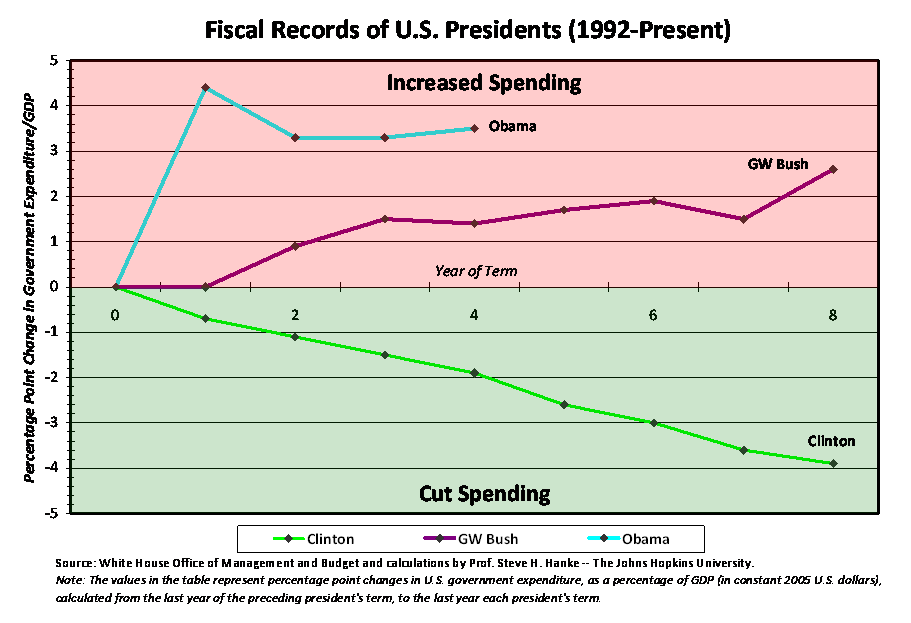
How can this be? To even say such a thing verges on CPAC blasphemy. Well, as usual, the data don’t lie. Let’s see how Clinton stacks up against Presidents Barack Obama and George W. Bush. As the accompanying chart shows, Clinton was the king of the fiscal squeeze.
Yes, Bill Clinton cut government’s share of GDP by a whopping 3.9 percentage points over his eight years in office. But, what about President Ronald Reagan? Surely the great champion of small government took a bite out of spending during his two terms, right? Well, yes, he did. But let’s put Reagan and Clinton head to head – a little fiscal discipline show-down, if you will (see the accompanying chart).
And the winner is….Bill Clinton. While Reagan did lop off four-tenths of a percentage point of government spending, as a percent of GDP, it simply does not match up to the Clinton fiscal squeeze. When President Clinton took office in 1993, government expenditures accounted for 22.1% of GDP. At the end of his second term, President Clinton’s big squeeze left the size of government, as a percent of GDP, at 18.2%. Since 1952, no other president has even come close.

Cato: Genetically Modified Choice

The New York Times reports today that Whole Foods, Trader Joe’s, and Aldi supermarket chains have decided not to sell a new form of genetically modified fish.  The FDA is set to approve the sale of a type of salmon genetically engineered to mature more quickly than its natural ancestors.  This will be the first genetically modified animal approved for human consumption.  While the FDA has determined that the genetic alteration of the fish has no effect on its meat, “Frankenfish”—as some have called it—still gives many consumers the heebie-jeebies. 
I would just like to point out that consumer demand for natural fish has prompted a market response that provides convenient access for GM-wary eaters while (most importantly) preserving choice for less-cautious consumers.  Mandatory labels like those proposed last year in California were not needed to ensure consumers received desired information; retailers have filled that function instead. 

Read more at 

Cato: 50 Vetoes: How States Can Stop the Obama Health Care Law

Today, the Cato Institute releases my latest working paper, “50 Vetoes: How States Can Stop the Obama Health Care Law.” From the executive summary:
Despite surviving a number of threats, President Obama’s health care law remains harmful, unstable, and unpopular. It also remains vulnerable to repeal, largely because Congress and the Supreme Court have granted each state the power to veto major provisions of the law before they take effect in 2014.
The Patient Protection and Affordable Care Act (PPACA) itself empowers states to block the employer mandate, to exempt many of their low- and middle-income taxpayers from the individual mandate, and to reduce federal deficit spending, simply by not establishing a health insurance “exchange.” Supporters of the law do not care for this feature, yet they adopted it because they had no choice. The bill would not have become law without it.
To date, 34 states, accounting for roughly two-thirds of the U.S. population, have refused to create Exchanges. Under the statute, this shields employers in those states from a $2,000 per worker tax that will apply in states that are creating Exchanges (e.g., California, Colorado, New York). Those 34 states have exempted at least 8 million residents from taxes as high as $2,085 on families of four earning as little as $24,000. They have also reduced federal deficits by hundreds of billions of dollars.

Read more at http://www.cato.org/blog/50-vetoes-how-states-can-stop-obama-health-care-law

Cato: School Board Votes to Shutter Three of California’s Top Schools

On Wednesday, the Oakland school board voted 4–3 to close three of California’s highest performing schools: the American Indian Model (AIM) charter schools. When Ben Chavis took over the American Indian Public Charter School just over a decade ago, it was the worst peformer in Oakland—an utter shambles. Today, it and the two sister schools Chavis created are among the highest-performing in the entire state. I know—I did the math. In a 2011 study comparing the performance of all of California’s charter school networks, I found that AIM was #1 by a wide margin. For contrast, I included in the study two of the state’s most elite, academically selective high schools: Lowell in San Francisco and Gretchen Whitney outside of Los Angeles. After controlling for student characteristics and peer effects, the AIM network beat them both—not just on the official state tests, but on the Advanced Placement tests administered by the College Board as well. More remarkable, AIM accomplished all that while spending less per pupil than the Oakland Unified School District, whose performance is abysmal by comparison. And that’s the great irony of the school board’s vote to close the AIM schools: the board accuses Ben Chavis, who is now retired, of fiscal irregularities or mismanagement during his tenure. Think about that: The board’s own schools are expensive failures. The AIM network is an incredibly cost-effective success. Yet somehow Chavis is the one accused of mishandling a budget? The core of the allegations seems to be that Chavis, who has a real-estate business, leased space to his schools and made money from that transaction, while vaulting AIM schools to stratospheric success. So, naturally, we should punish his schools. $#%#?!?

Read more at http://www.cato.org/blog/three-californias-top-schools-be-shuttered

Cato: Ryan Budget Proposal Is Not a Blueprint for Limited Government

The now annual release of House Budget Committee chairman Paul Ryan’s (R-WI) budget proposal has replaced the release of the president’s budget proposal as my least favorite policy event of the year. The president promises big government and Ryan promises smaller big government. What makes the Ryan proposal more aggravating is that it’s hardly a vision of limited government, but the left (and many on the right) treats it like it is.   
According to his numbers, Ryan’s budget ideas would reduce federal spending as a percentage of GDP from 22.2 percent this year to 19.1 percent in 2023. According to Democrats and liberals, such a savage reduction in the federal footprint would inflict unfathomable pain on various groups of Americans. 

Cato: Judge Strikes Down Bloomberg’s Soda Grab

My new op-ed at the Daily Caller is their “most shared” this morning. Excerpt:
On Monday, Judge Tingling struck down the soda ban in a sweeping opinion that does everything but hand Mayor Poppins his umbrella and carpetbag. This wasn’t just a temporary restraining order putting the regulation on hold for a few weeks. The judge struck down the ban permanently both on the merits (“fraught with arbitrary and capricious consequences”) and as overstepping the rightful legal powers of the New York City Department of Health…
[For] the mayor and his public health crew… the biggest reproach in the decision isn’t in being found to have gotten the facts wrong, it’s being found to have violated the law.
And if anyone is expected to know and play by the rules, it’s a nanny.

Read more at http://www.cato.org/blog/judge-strikes-down-bloombergs-soda-grab

Cato: Rare “It’s Not as Bad as We Thought” Finding Published

From the authors of a new paper just-published in the journal Nature Geoscience comes this surprising finding:
Tropical forests are less likely to lose biomass – plants and plant material – in response to greenhouse gas emissions over the twenty-first century than may previously have been thought.
A rare “not as bad as we thought” admission about the impacts of manmade global warming!
Not only that, but based on recent findings that the true climate sensitivity is much lower than climate models emulate—findings not incorporated in new study—the results are probably still even more “not as bad as they thought” than they thought!
Chris Huntingford from the U.K’s Centre for Ecology & Hydrology and colleagues coupled climate model projections to a land surface/vegetation model to see how the tropical forests in the Americas, Africa, and Asia respond to changes in atmospheric conditions. Their vegetation model includes interactions between terrestrial plants and influences such as temperature, precipitation, and the carbon dioxide concentration of the atmosphere (a plant fertilizer).
Unlike other studies which used a very limited selection of climate models and less sophisticated vegetation models, the Huntingford team found that in virtually all future simulations that the biomass of tropical forests increases over the course of the 21st century. This is a significantly different result than many previous which suggested that anthropogenic climate change would lead to, as Huntingford et al. put it, “catastrophic losses of forest cover and biomass.”
Perhaps most interestingly, the major driver for the biomass increase is the projected growth in atmospheric carbon dioxide concentration (thanks to our use of fossil fuels). The model projected changes in precipitation had little impact on the biomass predictions and the projected increase in temperature acted to decrease the biomass (although not as much as additional carbon dioxide acted to increase it).

Cato: Bloomberg’s Soda Grab and the Separation of Powers

I’m at the Commentary magazine blog this morning with a second bite (second gulp?) at the NYC soda ban ruling. This time I look at the separation-of-powers angle, and at the way Judge Milton Tingling, Jr.’s ruling addressed the overgrown ambitions of some in the “public health” community to control more and more of life. Although the decision did not forestall the New York City Council from adopting nanny-state regulations in the future should it see fit, I argue, 
…yesterday’s decision should cheer us for other reasons. It holds the Gotham administration accountable for overstepping the separation of powers, an important principle in the safeguarding of liberty. (In a profile of Judge Tingling, the New York Times notes that he’s been skeptical of government claims to power in a number of other cases as well.) 
Under separation of powers as generally understood at the time of the Framers, an executive agency cannot enact new legislation on its own, that being a role constitutionally reserved for the legislature. Especially during the Progressive Era and New Deal, these barriers were eroded as administrative agencies claimed a power to issue regulations that looked more and more like traditional legislation, under powers deemed to have been delegated by the legislature. Still, there are some limits, both under the U.S. Constitution and in New York (which under a 1987 case called Boreali v. Axelrod applies its own, quirky standard in evaluating whether a regulation oversteps the separation of powers.) And those limits to delegation were at the heart of the soda case.

Read more at http://www.cato.org/blog/bloombergs-soda-grab-separation-powers

2013-07-03

Cato: Sequestration Is a Small Victory for Budget Hawks

The budget battles in Washington, D.C., are far from over. President Obama’s attempt to break the stalemate by reaching across the aisle and dining with GOP members two days in a row seems more about show than substance. 
The apparent lack of urgency to undo the cuts underscores what we knew all along: the world did not end under sequestration. Most of the cuts will be phased in over the next few months. The defense cuts amount to just 6.5 percent of total spending on national security (Pentagon base budget plus war costs). This is a pittance, and spending will still dwarf what we spent before 9/11. Those who claim that the cuts will undermine American security should explain how we managed to win the Cold War while spending much less, on average. (To learn more about proposals that would maintain a highly capable, but less costly, military, attend our event on March 14th.) 
There is still the possibility that most of this year’s cuts, or the caps on planned spending over the next decade, may not materialize. Congress could reverse the cuts in the future as part of a grand bargain. Or they could simply punt without one. Meanwhile, legislation is moving along that would allow the Pentagon and other agencies to implement the cuts with greater discretion across department programs. This is a good thing, potentially. Smarter cuts are desirable, but we should be on the lookout to ensure that Congress doesn’t simply legislate away any cuts, dumb or otherwise. 

Cato: Mr. Paul Goes to Washington

As Sen. Rand Paul acknowledged early on in his epic 13-hour speech Wednesday (highlights here), his decision to mount an old-fashioned, talk-till-you-drop filibuster of John Brennan’s confirmation as CIA director didn’t really have much to do with Brennan personally. But neither was it really, at a fundamental level, about the narrow question of whether the president can “drop a Hellfire missile on your cafe experience” as you sit sipping a latte on American soil. If any citizens were realistically worried about that prospect, Attorney General Eric Holder has (somewhat belatedly) answered that question in the negative, prompting Paul to declare victory on that front.
But as Wired’s Spencer Ackerman observes, the spectre of Predators over Starbucks actually served to spotlight the “extraordinary breadth of the legal claims that undergird the boundless, 11-plus-year ‘war on terrorism’ ”—and to frame a much broader and more wide-ranging critique of that “perpetual war,” in which Paul charged that Congress has abdicated its responsibilities to an unaccountable executive branch. In Paul’s view, “we shouldn’t be asking [the president] for drone memos”—documents laying out the legal basis for the CIA’s targeted killing program, which the administration has finally, grudgingly deigned to provide to Congress, though not the American public—”we should be giving him drone memos.” As if to highlight the erosion of statutory checks on the president’s counterterror authority, Sen. Lindsey Graham declared that, after all, the Authorization for the Use of Military Force passed after 9/11 made no exception for actions “in the United States”—even though Congress had specifically rejected a request to include that phrase in the authorization.

Cato: Banzhaf’s Boast: “Undergrads Required to Lobby for Obama Policy”

I normally resist the temptation to pay attention to George Washington University law professor John Banzhaf, given his reputation as a bit of a publicity chaser, but this Monday press release from him was enough to get me to forsake my usual practice: 
Undergrads Required to Lobby for Obama Policy
At 4 PM today, undergraduate students in a major university will be assigned homework requiring them to lobby their local legislators in favor of a major Obama policy – fighting obesity.
FOR IMMEDIATE RELEASE PRLog (Press Release) - Mar. 4, 2013 - More specifically, some 200 undergrads will be asked to contact legislators in their home cities, counties, or states asking them to adopt legislation similar to that already adopted in New York City – and apparently to be considered in D.C., Cambridge, Mass, New York State, and perhaps elsewhere  – banning restaurants, delis, movie theaters and many other businesses from selling high-sugar drinks in cups or containers larger than 16 ounces.

Read more at http://www.cato.org/blog/banzhafs-boast-undergrads-required-lobby-obama-policy

Cato: Voting Rights in Massachusetts and Mississippi

During last week’s oral argument in Shelby County v. Holder – the challenge to Section 5 of the Voting Rights Act – Chief Justice Roberts questioned the Solicitor General concerning the rationality of the VRA’s coverage formula (Section 4(b)) by comparing non-covered Massachusetts with Mississippi, which remains subject to federal preclearance based on registration and voting data from 1964.  As the Chief Justice pointed out (page 32 of the transcript), Massachusetts has the “worst ratio of white voter turnout to African American voter turnout” while Mississippi “has the best.”  Massachusetts likewise “has the greatest disparity in registration between white and African American” while Mississippi is third best in the nation, “where again the African American registration rate is higher than the white registration rate.”
The Chief Justice’s remarks apparently angered the Massachusetts Secretary of State.  According to a Politico story, Secretary William Galvin found it “just disturbing that the chief justice of the United States would spew this kind of misinformation” and that the “2010 numbers don’t support what Roberts is saying.”  Galvin continued: “He’s wrong, and in fact what’s truly disturbing is not just the doctrinaire way he presented by the assertion, but when we went searching for an data that could substantiate what he was saying, the only thing we could find was a census survey pulled from 2010 … which speaks of noncitizen blacks … .  We reached out to academics at many institutions … and they could find no record either, they were puzzled by [Roberts’s] reference.”

Cato: DNA and Doctrine in the Supreme Court

This week, the Supreme Court considered whether collecting DNA from an arrestee was an unreasonable Fourth Amendment search.
Or at least that would have been a good way for the Court to frame the question.
Instead, much of the oral argument in Maryland v. King dealt with the question whether swabbing the cheek of an arrestee to take a DNA sample upsets one’s reasonable expectations of privacy. The “reasonable expectation of privacy” test is doctrine that arose from Justice Harlan’s concurrence in Katz v. United States. The test asks whether a person claiming the Fourth Amendment’s protections had a subjective expectation of privacy and whether it is “one that society is prepared to recognize as ‘reasonable.’”
The government’s case rests on that framing, which is why Deputy Solicitor General Michael Dreeben began his argument by saying that arrestees are “on the gateway into the criminal justice system. They are no longer like free citizens who are wandering around on the streets retaining full impact Fourth Amendment rights. The arrest itself substantially reduces the individual’s expectation of privacy.”

Cato: Google Illuminates the Shadowy World of National Security Letters

In a pretty much unprecedented move, Google today announced that it was expanding its regular “Transparency Report” to include some very general information about government demands for user information using National Security Letters, which can be issued by the head of any of 56 FBI field offices without judicial approval or supervision. Recipients of NSLs are typically forbidden from ever revealing even the existence of the request, and therefore not included in the company’s general tally of government surveillance requests. Instead of disclosing specific numbers of NSL requests, then, Google is publishing a wide range indicating the rough volume of requests they get each year, and how many users are affected. Broad as these ranges are, there’s some interesting points to be gleaned here:
It’s illuminating to compare the minimum number of users affected by NSLs each year to the numbers we find in the government’s official annual reports. In 2011—the last year for which we have a tally—the Justice Department acknowledged issuing 16,511 NSLs seeking information about U.S. persons, with a total of 7,201 Americans’ information thus obtained. That’s actually down from a staggering 14,212 Americans whose information DOJ reported obtaining via NSL the previous year. Remember, this total includes National Security Letters issued not just to all telecommunications providers—including online services like Google, broadband Internet companies, and cell phone carriers—but also “financial institutions,” which are defined broadly to include a vast array of businesses beyond such obvious candidates as banks and credit card companies.